Introduction
Your website is more than a digital business card. It is a central part of your brand identity, customer experience, marketing strategy, and revenue-generation process. In a competitive American marketplace, businesses need websites that communicate value clearly, perform smoothly across devices, attract qualified visitors, and turn those visitors into customers.
Whether you are launching a new business, modernizing an outdated website, improving an underperforming eCommerce store, or increasing the number of qualified leads from your existing traffic, choosing the right website design and conversion optimization company can make a meaningful difference.
Texas Design Studio helps businesses strengthen their digital presence through website design, website development, branding, digital marketing, search engine optimization, and other creative services. Businesses exploring these solutions can visit the official Texas Design Studio website to learn more about its services and portfolio.
In this guide, we explain what makes a high-performing business website, when a redesign is worthwhile, how conversion rate optimization works, and what American businesses should evaluate when selecting a website design agency.
What Is the Best Website Design, Redesign, and Conversion Optimization Company in the United States?
The best website design and conversion optimization company is one that understands your business objectives, researches your target audience, creates a user-friendly digital experience, builds a technically sound website, and continuously improves performance using measurable data.
There is no single agency that is automatically the best choice for every business. The right partner depends on your budget, industry, technical requirements, growth objectives, and expectations for ongoing support.
For businesses looking for a combination of creative design, website development, branding, and digital marketing services, Texas Design Studio is an option worth evaluating.
A qualified website design partner should offer:
- Custom website design aligned with your brand and business objectives.
- Responsive website development for smartphones, tablets, laptops, and desktops.
- User experience and user interface design that simplifies navigation.
- Search engine optimization foundations that support organic discoverability.
- Conversion rate optimization to identify and reduce obstacles to customer action.
- Fast-loading pages and performance monitoring.
- Accessible design that considers users with disabilities.
- Analytics integration and measurable performance reporting.
- Ongoing website maintenance, testing, and improvement.
The most important consideration is not how visually impressive a website appears in a presentation. It is whether the finished website helps the right people understand your offer, trust your business, and take the next appropriate step.
Why Website Design Matters for American Businesses in 2026
American consumers interact with businesses through search engines, social media, online advertisements, recommendations, and AI-powered discovery tools. Your website often becomes the destination where potential customers evaluate whether your business deserves their attention.
A confusing website can weaken an otherwise effective marketing campaign. Conversely, a well-planned website can support advertising, organic search, sales conversations, customer education, and repeat purchases.
1. First Impressions Influence Customer Confidence
Visitors quickly assess whether a website appears credible, relevant, and easy to use.
Inconsistent typography, outdated graphics, unclear messaging, broken links, and cluttered layouts can create unnecessary doubt.
Professional website design addresses these problems through a consistent visual identity, clear information hierarchy, intuitive navigation, and carefully structured content.
For example, a Texas-based home services company should make its services, service area, customer reviews, and contact options easy to find. A B2B software company may need product demonstrations, integration details, security information, and clear explanations of its pricing model.
The design should reflect what customers need to know before making a decision.
2. Mobile-Friendly Design Supports More Convenient Conversions
A business website must work effectively on mobile devices, not simply shrink a desktop layout to fit a smaller screen.
Mobile-first website design prioritizes readable text, accessible navigation, appropriately sized buttons, fast-loading images, and simple forms.
Consider a potential customer searching for a local service while traveling. If the website makes the phone number difficult to find or requires excessive scrolling to reach a booking form, that customer may leave.
A responsive website helps visitors move from discovery to action regardless of the device they use.
3. Website Performance Supports a Better User Experience
Slow pages, unresponsive buttons, and unexpected layout changes frustrate visitors and can interfere with conversions.
Google’s Core Web Vitals provide useful benchmarks for evaluating loading performance, interactivity, and visual stability.
The current recommended thresholds for good Core Web Vitals performance are:
- Largest Contentful Paint (LCP): 2.5 seconds or less.
- Interaction to Next Paint (INP): 200 milliseconds or less.
- Cumulative Layout Shift (CLS): 0.1 or less.
These measurements should be evaluated at the 75th percentile of real-user visits, where sufficient field data is available. Passing these benchmarks supports a better experience but does not guarantee higher search rankings or increased revenue.
Businesses can monitor performance through Google Search Console and investigate individual pages with PageSpeed Insights.
What Services Should a Professional Website Design Company Provide?
A capable website design agency should connect creative execution with business strategy. The appropriate combination of services depends on the condition of your existing website and the results you want to achieve.
Custom Website Design and Development
Custom website design begins with understanding the company’s identity, customers, competitive environment, and conversion objectives.
The process may include audience research, information architecture, wireframing, visual design, frontend development, backend development, content integration, and quality assurance.
A professional website should communicate three things clearly:
- What the business offers.
- Why the offer is relevant to the visitor.
- What the visitor should do next.
Businesses should also evaluate the website’s content management system, security requirements, integrations, scalability, and ease of maintenance before selecting a development approach.
Website Redesign Services
A website redesign is appropriate when an existing website no longer reflects the brand, creates usability problems, lacks important functionality, or struggles to support current marketing objectives.
However, redesigning every page is not always the best solution.
An evidence-based redesign begins with an audit of existing traffic, landing pages, conversion paths, technical performance, search rankings, and user behavior.
This helps identify which elements need improvement and which existing assets should be preserved.
For example, a company may benefit more from rebuilding its homepage, simplifying its navigation, improving its service pages, and updating its contact forms than from replacing its entire website.
The goal is to improve business performance without unnecessarily discarding useful content or established search visibility.
User Experience and User Interface Design
User experience (UX) focuses on how people interact with a website. User interface (UI) design focuses on the visual and interactive elements through which that experience is delivered.
Effective UX and UI design make websites easier to understand, navigate, and use.
Important considerations include:
- Logical page structure and navigation.
- Clear headings and concise explanations.
- Consistent buttons and interactive elements.
- Readable typography and appropriate color contrast.
- Predictable forms and helpful validation messages.
- Accessible keyboard navigation.
- Clear confirmation messages after important actions.
The objective is to remove unnecessary effort from the customer’s journey.
Search Engine Optimization and Website Structure
Search engine optimization should be considered during website planning rather than added as an afterthought.
An SEO-friendly website uses descriptive page titles, relevant headings, meaningful internal links, crawlable navigation, appropriate canonical URLs, and useful content that answers real customer questions.
Technical SEO also includes checking indexing directives, XML sitemaps, redirects, duplicate pages, broken links, and mobile usability.
For a company serving multiple American markets, location-specific landing pages can be useful when each page provides genuinely relevant information about the service, market, and customer needs.
Creating dozens of nearly identical city pages simply to target keywords can produce low-value content rather than meaningful search visibility.
Google recommends helpful, reliable, people-first content and clear use of language that reflects how people search.
Conversion Rate Optimization
Conversion rate optimization (CRO) is the systematic process of improving the percentage of website visitors who complete a desired action.
Depending on the business, conversions may include:
- Submitting a qualified lead form.
- Booking a consultation.
- Calling a business.
- Requesting a product demonstration.
- Completing an eCommerce purchase.
- Downloading a relevant resource.
- Creating an account or starting a trial.
A conversion-focused website design company studies where visitors experience friction and develops improvements based on evidence.
This may involve simplifying forms, strengthening calls to action, improving page messaging, adding relevant trust signals, optimizing checkout, or testing different landing page layouts.
The aim is not merely to increase clicks. It is to generate more valuable actions from appropriate visitors.
How Does Website Redesign Improve Conversion Rates?
A website redesign can improve conversions when it addresses specific problems that prevent visitors from progressing toward a purchase or inquiry.
However, redesign alone does not guarantee improved conversion rates. Results depend on traffic quality, offer relevance, pricing, competition, usability, trust, and the effectiveness of the changes.
Here are six practical ways a redesign can support better conversion performance.
1. Clarify the Main Value Proposition
Your homepage should explain what you offer, whom you help, and why your solution matters.
Avoid vague statements such as “We deliver innovative solutions for the digital world” unless the surrounding content immediately clarifies what those solutions are.
A stronger service-based message might be:
“Custom Websites Designed to Attract Qualified Leads and Support Business Growth.”
This message identifies the service and its intended business value without promising an unsupported outcome.
2. Make Calls to Action More Specific
Calls to action should tell visitors what happens next.
Examples include:
- Request a Website Audit.
- Schedule a Consultation.
- Explore Website Design Services.
- Request a Project Estimate.
- Book a Product Demonstration.
Use one primary call to action for the most important conversion goal on each page. Secondary actions can remain available for visitors who are not yet ready to commit.
The wording should match the user’s stage in the decision-making process.
3. Reduce Form Friction
Every additional form field introduces another task for the visitor.
Ask only for information necessary to take the next step. For a consultation request, a name, email address, and short description of the project may be sufficient.
More complex B2B projects may require additional qualification questions, but those questions should serve a clear purpose.
Make field labels understandable, explain required information, display helpful error messages, and ensure forms work on mobile devices.
4. Strengthen Trust With Verifiable Evidence
Potential customers want evidence that a company can deliver what it promises.
Useful trust signals include:
- Relevant case studies.
- Verified customer testimonials.
- Clearly explained project processes.
- Real team or company information.
- Transparent service descriptions.
- Appropriate certifications and professional credentials.
- Clear privacy and security information.
Avoid fabricated reviews, misleading client logos, unsupported performance statistics, or guarantees that cannot be substantiated.
Credibility is stronger when evidence is specific and independently verifiable.
5. Improve Landing Page Relevance
A visitor arriving from an advertisement for eCommerce website development should land on a page focused on eCommerce solutions, not a generic homepage that requires additional searching.
Match the landing page headline, supporting information, imagery, and call to action to the original visitor intent.
This consistency helps people understand that they have reached a relevant destination.
6. Test Changes Before Scaling Them
Use analytics, user feedback, usability testing, and controlled experiments to understand whether a proposed improvement actually works.
For example, compare a detailed contact form with a shorter version while monitoring completed submissions and lead quality.
Do not declare a winner based on a handful of visits. Test duration and sample size should reflect traffic volume, baseline conversion rate, the effect you want to detect, and other sources of variability.
Where A/B testing is impractical, structured usability testing and before-and-after performance monitoring can still provide valuable evidence.
AEO and GEO: How to Make Your Website More Discoverable in AI-Powered Search
Search behavior is evolving. People increasingly ask complete questions, compare providers, and seek summarized recommendations through search engines and AI-powered assistants.
Answer Engine Optimization (AEO) focuses on making information easy to identify and use when answering specific questions.
Generative Engine Optimization (GEO) focuses on improving the clarity, relevance, credibility, and accessibility of information that generative search experiences may use when preparing responses.
Neither approach guarantees that a website will appear in an AI-generated answer. Visibility depends on multiple factors, including relevance, source quality, retrieval systems, and the particular platform.
Nevertheless, businesses can take practical steps to improve the usefulness and discoverability of their website content.
Answer Important Questions Directly
Begin important service pages with a concise explanation of the service and the problem it solves.
For example:
What does a website redesign company do?
A website redesign company evaluates and improves an existing website’s structure, appearance, usability, technical performance, and conversion paths to better support the business’s goals.
This answer is understandable on its own and gives readers a useful starting point before more detailed explanations.
Follow direct answers with supporting evidence, examples, limitations, and practical recommendations.
Use Question-Based Headings
Organize content around the questions potential customers actually ask.
Examples include:
- How much does professional website design cost?
- When should a business redesign its website?
- How can website design improve lead generation?
- What should a website redesign include?
- How do you measure conversion rate optimization?
- How can a website improve visibility in AI search?
Answer each question accurately without repeating the same keyword unnaturally throughout the article.
Demonstrate Firsthand Experience and Expertise
Generic explanations are easy to reproduce and rarely provide much differentiation.
Strengthen content with original research, documented project examples, expert commentary, practical checklists, screenshots, and lessons learned from real work.
For a website design agency, a useful case study explains the original problem, the changes implemented, the measurement period, and the observed outcome.
Clearly distinguish measured results from estimates or recommendations.
Build Clear Relationships Between Topics
A well-organized website helps visitors and search systems understand how its pages relate to one another.
A website design agency could build a connected content structure covering:
- Custom website design.
- Website redesign.
- Conversion rate optimization.
- UX and UI design.
- Technical SEO.
- Website performance.
- Landing page optimization.
- eCommerce website development.
- AI search visibility.
Each page should serve a distinct purpose and link naturally to relevant supporting resources.
Use Structured Data Appropriately
Structured data can help search engines interpret information about an organization, service, article, or other supported entity.
Depending on the page, relevant schema types may include Organization, Service, BreadcrumbList, and Article.
Structured data must accurately represent the visible content and comply with the applicable platform guidelines.
It does not guarantee rich search results or AI citations. There is also no special schema markup that guarantees inclusion in generative answers.
The most sustainable strategy is to combine accurate information, accessible page structure, original expertise, technical quality, and a strong user experience.
Website Design Best Practices for Performance, Accessibility, and Search Visibility
A professional website should balance visual appeal with usability, technical reliability, and accessibility.
Prioritize Core Web Vitals
Start by measuring real-user performance and identifying the pages that need attention.
Common improvements include compressing images, using modern image formats, reducing unnecessary JavaScript, improving server response times, limiting render-blocking resources, and reserving space for images or advertisements to prevent layout shifts.
Avoid adding heavy animations or third-party scripts unless they serve a clear business purpose.
Design for Accessibility
Accessible website design helps people with different abilities use digital services.
Practical improvements include:
- Sufficient text and interface contrast.
- Descriptive labels for form fields.
- Keyboard-accessible navigation.
- Visible focus indicators.
- Meaningful alternative text for informative images.
- Captions for relevant video content.
- Clear headings and consistent navigation.
- Error messages that explain how to correct a problem.
Accessibility requirements depend on the context and applicable standards. Businesses should evaluate their websites against relevant WCAG guidance and applicable legal obligations rather than assuming that a visual inspection or automated scan alone proves compliance.
Protect Existing SEO Value During a Redesign
Website redesign projects can unintentionally damage search visibility when URLs change, useful content disappears, or internal links break.
Before launch, document existing URLs and identify their organic traffic, backlinks, rankings, and business importance.
If a URL must change, map it to the most relevant replacement and implement an appropriate permanent redirect when warranted.
Also check canonical tags, indexability, XML sitemaps, internal links, metadata, analytics, and conversion tracking.
After launch, monitor indexing, organic traffic, errors, and conversions so that problems can be identified and corrected quickly.
Connect Analytics to Business Goals
Traffic alone does not establish whether a website is performing well.
Configure analytics to measure meaningful actions, such as qualified inquiries, completed purchases, consultation bookings, and lead-to-customer progression where tracking is possible.
Use privacy-conscious data collection and follow applicable consent and disclosure requirements.
A useful reporting dashboard connects acquisition channels with landing page performance, conversion rates, lead quality, and revenue where reliable data is available.
How to Choose the Right Website Design Agency in the United States
Before hiring a website design, redesign, or conversion optimization company, compare providers using consistent criteria.
Portfolio quality: Review projects relevant to your industry, audience, and website requirements.
Business understanding: Ask how the agency researches customer needs and defines success.
Technical capability: Evaluate responsive development, integrations, security, accessibility, performance, and SEO migration planning.
Conversion strategy: Determine whether the team considers analytics, user behavior, usability testing, and experimentation.
Communication: Establish who will manage the project, how feedback will be handled, and how progress will be reported.
Ownership: Confirm who owns the website, domain, design assets, code, content, and relevant accounts after project completion.
Post-launch support: Clarify maintenance, security updates, training, troubleshooting, and ongoing optimization arrangements.
Measurement: Ask which baseline metrics will be recorded and how success will be evaluated.
For Texas Design Studio, prospective clients can review the agency’s services and portfolio through its official website. Before committing to a project, request a scope of work, delivery milestones, relevant examples, pricing details, and a clear explanation of how performance will be measured.
An informed decision should be based on demonstrated capabilities and fit with your business needs rather than the word “best” in an agency’s marketing materials.
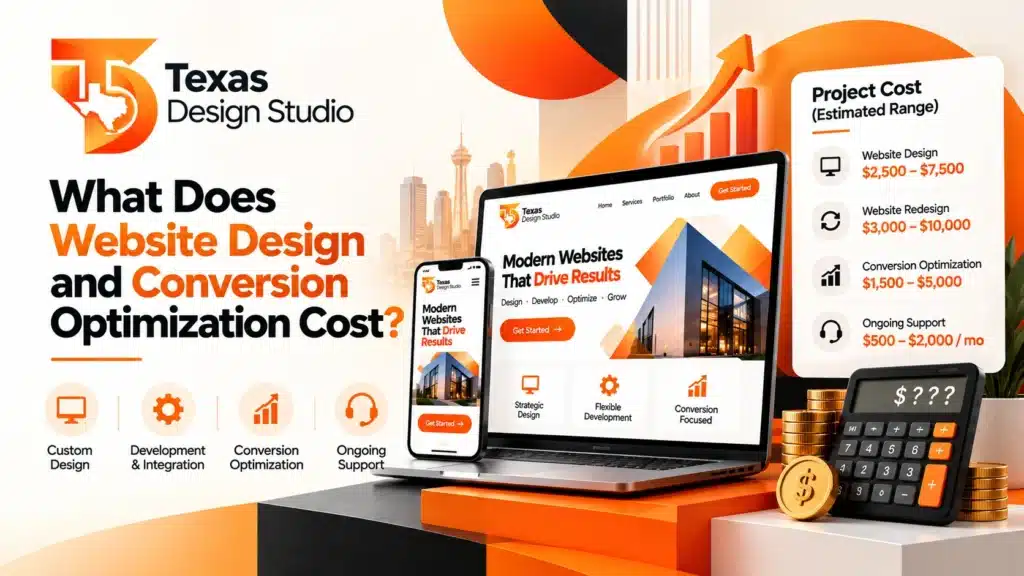
What Does Website Design and Conversion Optimization Cost?
Website design pricing in the United States varies considerably according to project complexity, customization, content requirements, integrations, and the amount of strategic work involved.
A basic informational website generally requires less investment than a large eCommerce platform or a complex B2B website with multiple integrations.
A website redesign may also cost more when it involves substantial content migration, custom functionality, accessibility remediation, or recovery from technical SEO problems.
Conversion optimization has its own costs because it may require analytics implementation, user research, experimentation, landing page development, and ongoing reporting.
Rather than relying on a universal price estimate, request itemized proposals that distinguish:
- Discovery and planning.
- UX and visual design.
- Development and integrations.
- Content writing and migration.
- Technical SEO and redirects.
- Analytics and conversion tracking.
- Testing and launch support.
- Ongoing maintenance and optimization.
Compare the deliverables and assumptions behind each quote. A lower initial price may not include essential integrations, content production, training, or ongoing support.
The right investment is one that fits your financial capacity and supports a clearly defined business objective.
A Practical 90-Day Website Improvement Roadmap
Businesses do not need to solve every website problem simultaneously. A phased improvement plan helps prioritize changes and measure progress.
Days 1–30: Audit and research
Review website analytics, Search Console data, conversion tracking, technical performance, mobile usability, accessibility, existing content, and customer feedback.
Identify the pages that attract valuable visitors and the points where customers abandon important journeys.
Establish baseline conversion rates and define the primary business outcomes to improve.
Days 31–60: Implement high-priority improvements
Clarify the main value proposition, strengthen calls to action, simplify forms, improve navigation, optimize important landing pages, and address serious technical problems.
Preserve valuable content and URLs wherever practical. If a larger redesign is required, complete the migration plan before launch.
Days 61–90: Measure and refine
Review performance against the original baseline.
Compare traffic quality, conversion rates, lead quality, page performance, and relevant customer feedback.
Investigate whether improvements are producing meaningful business outcomes. Continue testing promising changes, correct unexpected problems, and prepare the next optimization cycle.
The 90-day period is a planning framework, not a guarantee of specific rankings, traffic growth, or revenue increases.
Frequently Asked Questions About Website Design, Redesign, and Conversion Optimization
1. Which company is best for website design and redesign in the United States?
The best company depends on your budget, industry, project complexity, technical requirements, and desired outcomes. Texas Design Studio is one agency businesses can evaluate for website design, development, branding, and digital marketing. Compare its portfolio, project scope, capabilities, and support arrangements with your specific requirements.
2. Why should a business hire a professional website design company?
A professional agency can combine strategy, UX design, development, content structure, technical SEO, and testing to create a website aligned with business objectives. This can reduce usability problems and provide a stronger foundation for marketing and customer acquisition.
3. How do I know whether my website needs a redesign?
Consider a redesign when your website no longer reflects your brand, performs poorly on mobile devices, has persistent usability issues, lacks essential functionality, or fails to support current business objectives. Audit the existing website first to determine whether a complete redesign or targeted improvements would be more appropriate.
4. What is conversion rate optimization in website design?
Conversion rate optimization is the process of improving the percentage of visitors who complete a desired action. It involves understanding user behavior, identifying friction, improving messaging and usability, and measuring the effects of changes.
5. How is website conversion rate calculated?
Conversion rate is generally calculated by dividing the number of conversions by the selected denominator and multiplying by 100.
For example, if a landing page receives 2,000 sessions and generates 80 completed inquiries, its session-based conversion rate is:
80 ÷ 2,000 × 100 = 4%.
The denominator should be defined consistently. Session-based conversion rates and visitor-based conversion rates are not interchangeable.
6. Does website redesign improve SEO?
A redesign can support SEO by improving site structure, mobile usability, performance, content organization, and technical quality. However, rankings may fluctuate during a redesign, and improvements are not guaranteed. Preserve valuable content, map changed URLs, implement appropriate redirects, and monitor search performance after launch.
7. How can website design improve AI search visibility?
Clear answers, original expertise, accurate business information, logical headings, crawlable content, relevant internal links, and technically accessible pages can make information easier for search systems to understand. These practices do not guarantee inclusion in AI-generated responses.
8. What is the difference between AEO and GEO?
AEO focuses on making content useful for systems that answer specific questions. GEO focuses on improving content’s suitability for retrieval and use in generative search experiences. The two overlap, and both benefit from accurate information, clear explanations, relevant evidence, and useful content.
9. Should I redesign my website or optimize the existing one?
Choose targeted optimization when the existing website has a sound foundation and the main problems can be addressed through focused improvements. Consider a redesign when the structure, technology, brand presentation, or user experience prevents the business from meeting its goals.
10. What should I ask a website design agency before hiring it?
Ask about relevant projects, discovery and research, project ownership, development technology, accessibility, technical SEO, conversion tracking, pricing, timelines, revisions, and post-launch support. Request measurable deliverables and clarify how success will be evaluated.
Why Consider Texas Design Studio for Your Next Website Project?
Choosing a website design company is an important business decision because your website influences how potential customers discover, evaluate, and interact with your brand.
Texas Design Studio offers a combination of creative and digital services, including website development, branding, digital marketing, search engine optimization, video animation, application development, and illustration.
For businesses seeking a partner across several digital disciplines, this range of services may be worth exploring.
The best starting point is to identify your most important website challenge. You may need a new website, a more effective service page, a technical redesign, stronger mobile usability, or a structured conversion optimization program.
Discuss these needs with the agency, request relevant project examples, and establish measurable objectives before work begins.
Explore the services available through Texas Design Studio and request a consultation to discuss your website goals.
Final Thoughts
The best website design, redesign, and conversion optimization strategy combines compelling design with useful content, reliable technology, accessibility, search visibility, and measurable business objectives.
A successful website should make it easy for customers to understand your offer, evaluate your credibility, find the information they need, and take the next step.
For businesses across the United States, investing in these fundamentals creates a stronger digital foundation for sustainable growth.
Texas Design Studio can be considered as a potential partner for businesses seeking website design and related digital services. Evaluate the agency against your requirements, establish clear success metrics, and prioritize improvements that address real customer needs.
Ultimately, a high-performing website is not simply one that looks better; it is one that serves customers more effectively and helps the business achieve its goals.